
“Band-in-a-Box teaches people how to play music, rather than replacing musicians altogether.” - An Interview with PG Music's Founder
Music software veteran Peter Gannon speaks with zplane about distinguishing PG Music’s products in the AI era, using zplane audio algorithms and more.
For more than three decades, Band-in-a-Box has remained one of the most influential tools in music composition and practice software. Long before generative AI entered the conversation, PG Music founder Peter Gannon was exploring how computers could behave more like real musicians – not to replace human creativity, but to support and enhance it.
In this interview, Peter reflects on the early days of music software development and the evolution of Band-in-a-Box, from MIDI accompaniment to Real Tracks. He also shares his perspective on today’s AI-powered music tools, the role of ethical audio technology, and how PG Music uses zplane’s advanced audio SDKs to continue pushing the boundaries of what music software can do.
Please could you introduce yourself, PG Music, and your role there?
I’m Peter Gannon, and I’m the founder and CEO of PG Music. We make smart music software for musicians – our main product is Band-in-a-Box, which has been around since the late 80s.
What was happening in the music software industry at that time?
This period was pretty much the beginning of the PC music software era, with the arrival of other programs like Finale, Cakewalk, and Dr. T’s, along with Band-in-a-Box. Before the Apple Mac came along, Atari computers were the go-to device for digital music production. And of course, there were IBM PCs too.
As you mentioned, Band-in-a-Box is your flagship product. It was also PG Music’s first product, so how did that come about?
I finished medical school in the early 80s, and had just become a fully fledged medical doctor. I’ve always been musical, and I wanted to continue to play music even though I was a practicing medical professional. I decided to write a small piece of software to help me practice.
“Like many creative pursuits, you set out to do one thing, and you end up doing something else.”
I was particularly interested in Jazz music, so I wrote a program that allowed me to digitally create a rhythm section, which I could play the guitar or piano along to. Like many creative pursuits, you set out to do one thing, and you end up doing something else. One thing led to another, and many years later, here we are.
That’s a lifetime in the technology industry! How has the product changed in that time?

To activate the video from YouTube, please click on the link. By activating the link, data will be transmitted to YouTube. Further information can be found in our privacy policy.
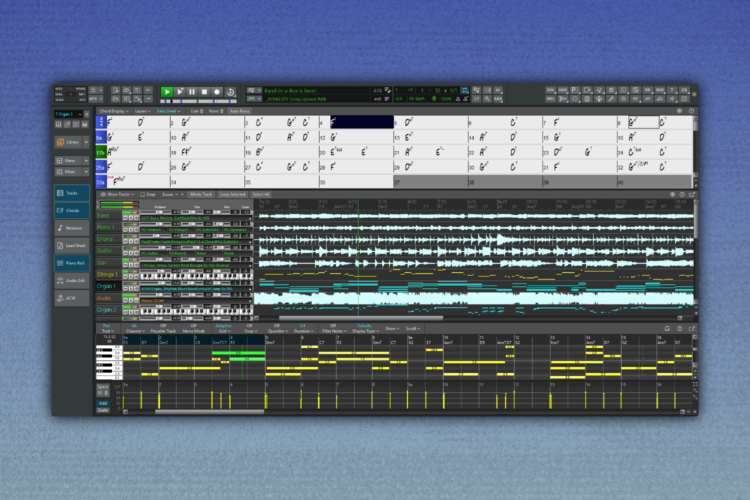
Band-in-a-Box is still going strong, and the basic idea is still there – you type your desired chords into something that resembles a spreadsheet, you click a style, and then you press play. The product has, of course, evolved over the years. Early on, everything was MIDI, as people were familiar with that.
When we created MIDI Styles, this was essentially someone sitting at a typewriter envisioning what a particular style might sound like. This was usually a computer programmer rather than an experienced musician.
Then we gradually transitioned from MIDI to Real Tracks, which are actual recordings of real musicians and come with all of the nuance of actual musical performances. This allowed us to bring in the actual knowledge of real, famous musicians with expertise in particular styles of music. This was the start of the next phase of Band-in-a-Box, which paved the way to what the product is today.
You mentioned you studied medicine, which seems a few steps removed from computer technology. Did you have any experience or formal education in coding, or did you have to teach yourself?
I had actually started programming at a young age in the 1970s. This looked very different from how it does today, and was a matter of typing in punch cards and things like that. But there was also some overlap between my medical studies and my interest in programming – I chose to take some modules on computerized medical diagnosis.
So computers have always been of interest to me. When personal computers first became available, my immediate thought was that it could be useful to try to get it to act like a human brain. Combined with my passion for music, it seemed obvious to me that there should be a music program that behaved like a musician. Much to my surprise, nothing like this existed, only sequencers and other programs that allowed you to record music.
Using the experience you had, how long did it actually take to develop the first version of Band-in-a-Box, and what were some of the main challenges you faced during the early stages of development?

To activate the video from YouTube, please click on the link. By activating the link, data will be transmitted to YouTube. Further information can be found in our privacy policy.
Not very long at all – less than a year, for sure. The main challenges we faced were musical matters. For example, I had to figure out what Bossa Nova drums sounded like, and how to write realistic Salsa pieces on the piano, and so on. Now, you can just search these things on the internet, but we didn’t have that option in the 80s.
To overcome this, I hired a drum teacher. Not to learn how to play drums, but to find out what makes a Bossa Nova drum beat – the instrumentation, drum patterns, grooves, and so on. The aim of Band-in-a-Box has always been to be musically accurate and realistic, so getting this aspect of the product right has always been our biggest challenge.
“Experienced musicians have always been at the core of the product.”
One thing I learned very early on is that, in general, musicians have an incredible amount of musical knowledge but very little computer knowledge, and the opposite is true for computer programmers. This means that a computer programmer could create a piece of music with a program, which they feel sounds realistic. But show it to an actual musician, and they can quickly tell that it wasn’t played by a human. Musicians know when all the notes are within one octave, or when a particular chord isn’t physically possible. For that reason, experienced musicians have always been at the core of the product.
So it would be fair to say that Band-in-a-Box is aimed at musicians as much as it is non-musicians?
Absolutely. There are high-end notation packages on the market, but they don’t tell you when something is voiced badly, that something is dissonant, or that a musician could or would never play a particular combination of notes. But these are the types of things that a musician notices right away.

To activate the video from YouTube, please click on the link. By activating the link, data will be transmitted to YouTube. Further information can be found in our privacy policy.
We made the program and all the music for the program, based on the assumption that the people using it are musicians who want to become better at music. The idea is that a guitar player can use the program to practice and refine their craft. Many musicians are visually oriented, so Band-in-a-Box has always shown what every musician in the band is doing. It’s displayed in notation form, or with an on-screen keyboard or fretboard.
“We have over 3000 hours of recordings of the best studio musicians in the world.”
Another thing that sets us apart from typical notation software is the quality and quantity of musical content available. We have over 3000 hours of recordings of the best studio musicians in the world, and when you find something you like, you can actually see how it’s played. You can slow it down, loop it, and watch the fretboard to learn how to do it. Band-in-a-Box teaches people how to play music, rather than replacing musicians altogether.
If the idea is for Band-in-a-Box to work alongside musicians rather than replace them, then presumably the advent of artificial intelligence isn’t a major concern for you?
Yes, exactly. If you love Bluegrass music, for example, you are actually hearing real Bluegrass musicians play authentic Bluegrass music. And you can see exactly how they're playing it. The idea is that you're going to learn how to play your instrument better, and how to compose compelling music for that particular instrument.
It’s a totally different product from the generative AI music tools out there now, and it has a totally different use case. It’s not just a matter of saying “give me a song that sounds like somebody running across a field, and then it starts raining”. It’s built for people who are enthusiastic about making music and have some level of existing musical knowledge.
“Band-in-a-Box is actual music, so it sits in a different lane from generative AI music tools.”
Thanks to Real Tracks, all of the musical content in Band-in-a-Box is real recordings of real musicians playing real instruments. They’re all hired and paid, and have agreed for the recordings to be used in our product. There’s a term for this in the context of creating audio, which is “ethical” – we aren’t training models, sampling or generating something that emulates music. Band-in-a-Box is actual music, so it sits in a different lane from generative AI music tools.
Band-in-a-Box and other PG Music products use a range of zplane’s advanced audio SDKs. How did you first come across our algorithms, and how have you implemented them in your product range?
We’ve been with zplane a long time and have a great relationship together. As we were developing everything ourselves in the early days, we had to write our own software to change the tempo and pitch of audio. We used this for Real Tracks for a few years before we finally discovered ELASTIQUE.
“We switched to using ELASTIQUE and never looked back.”
I wish I’d heard of zplane sooner – ELASTIQUE was and is the world’s best pitch-shifting and time-stretching software. We switched to using ELASTIQUE and never looked back. Since then, we’ve also licensed some other products, most recently the STEMS PRO stem separation algorithm, which is incredible. We also use the DRUMS and PITCHES drum and MIDI transcription products, which, once again, are best in class.

To activate the video from YouTube, please click on the link. By activating the link, data will be transmitted to YouTube. Further information can be found in our privacy policy.
zplane is a great company to work with, and we’ve had some great experiences working together. They’re really responsive to any questions we might have, and are receptive to suggestions for future updates to their products.
Aside from enhancing the functionality of your products, how has using zplane algorithms helped PG Music to develop industry-leading products?
Using dedicated audio algorithms like zplane’s has allowed us to focus our efforts on other aspects of our products, such as improving the interface or developing new features. It works really well for us – we don’t have to focus on everything that has to happen under the hood to transparently change the pitch or tempo of audio.
As I mentioned, the music is our priority. So we use zplane’s algorithms to take care of the technical stuff, while we continue to work on adding more musical styles and features to the product.
We’ve talked a little bit about the history of PG Music and Band-in-a-Box, but how do you see the product continuing to evolve over time?
The recent zplane algorithms we’ve added to Band-in-a-Box are fantastic, and open up so many possibilities for us throughout the whole process of using the product. Implementing zplane’s SDK libraries has allowed users to load a product, separate it into individual stems, transcribe each part into audio or MIDI, and then line up the tempos automatically. It all interfaces perfectly with our product, and allows users to make the most of the many styles of music it contains.
From its origins as a simple practice tool for musicians, to its position as one of the longest-running names in music software, Band-in-a-Box has consistently evolved alongside the industry without losing sight of its core audience and purpose.
As Peter explains throughout this conversation, the future of music technology is not simply about automation or replacing human creativity. Instead, it’s about building tools that empower musicians, preserve musical authenticity, and make advanced workflows more accessible. By combining decades of musical expertise with cutting-edge technologies like zplane’s audio processing algorithms, PG Music continues to demonstrate how innovation and musicianship can work hand in hand.
Thanks again to Peter for taking the time to speak with us. You can keep up with him and PG Music via their website.