
"AI will always be one step behind" - An Interview with Uwe and Julian of Ueberschall
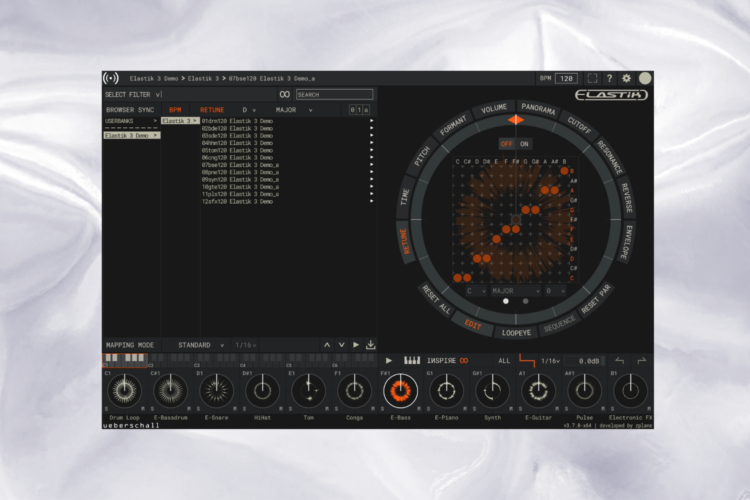
We hear from Ueberschall's head honchos about the innovative company's beginnings, licensing zplane algorithms, and AI's shortcomings.
Ueberschall has been shaping the sound of modern music production since the late 1980s, evolving from floppy-disk sample libraries to powerful software tools used by producers worldwide.
In this interview, founder Uwe and CEO Julian share the story behind the company’s origins, the development of their Elastik player, and how decades of innovation have kept them at the forefront of music technology. From early hardware samplers to today’s AI-driven landscape, they reflect on sample-based music production, and why human creativity still matters more than ever.

To activate the video from YouTube, please click on the link. By activating the link, data will be transmitted to YouTube. Further information can be found in our privacy policy.
Thanks for taking the time to speak to us. Would you mind introducing yourselves, Ueberschall, and what you both do there?
Uwe: I founded Ueberschall in 1987, focusing on the creation of samples and loops for professional music production. And while the circumstances have changed a lot since then, we still do that today.
Julian: I have been working at Ueberschall since 2012. I started out as an intern, then became a trainee, continued working there during my time at university. This year, I took over the responsibilities of CEO. At the beginning, I mostly did audio editing, but Uwe gradually introduced me to all areas of the company. From music production, mixing and mastering to web development, marketing, and customer support.
Did music technology come first, or were you musicians who identified a gap for a product and a demand from other musicians?
Uwe: In our family, music was everywhere. My father worked at Telefunken, so we always had two of everything at home. We had turntables, tape recorders, amplifiers, shortwave receivers, microphones, and all different kinds of speakers. In the mid-sixties, a relative gave me a gigantic record collection containing lots of cool stuff that I had never heard before. I experimented a lot with tape recorders and turntables, creating overdub recordings of radio plays. It was all one big playground for me.
In the early seventies, naturally, I wanted to become a guitarist. I started playing in sessions, and later performed gigs as a guitar duo with a drum machine and synth. I also played in some bands and in the studio. That’s where I first experienced the PPG Wave 2.2, and early hardware samplers like the Waveterm. That was the initial spark that convinced me that sampling would change the whole music industry.
"Today, people artificially add noise to their mixes during post-production."
A new sound was taking over in the eighties, and everyone who could afford one of those hardware sampler monstrosities started using samples in their productions. I started programming my own sounds for the Yamaha DX7 and bought my first Akai S612 sampler. People asked me to create sounds for them, and that’s how my business slowly got started.
For a few years, I worked closely with Klaus Schulze, which was a very intense and great time. I learned a lot from Klaus – he had all the equipment anyone could have wanted, and I could use it freely. It was a giant toy store of incredible synths and multiple Akai S1000/3000, a DD1000 optical recorder, and a Yamaha DMP7-D – a special digital version with a selected equalizer programmed to the specifications of the Deutsche Grammophon.

To activate the video from YouTube, please click on the link. By activating the link, data will be transmitted to YouTube. Further information can be found in our privacy policy.
Together with our mobile DAT recorders and some MKH20/40 microphones, we were able to produce high-quality sounds that remained fully in the digital domain – in 1987! The recordings were all edited digitally and put together as CD masters on the DD1000. That was the sound everyone wanted – no static noise at all! Today, people artificially add noise to their mixes during post-production.
Julian: I grew up taking classical piano lessons, which eventually evolved into an interest in synthesizers and electronic music. As a teenager, I saved up a lot of pocket money and bought my first synth, a Roland SH-201. Later, I got an Elektron Machinedrum MK-1 on eBay. I was really inspired by that machine, as I was able to sequence the SH-201 with it.
"I was immediately captivated by the Elastik player and its potential."
That's when my interest in music technology really began. After I joined Ueberschall in 2012, I was immediately captivated by the Elastik player and its potential, and I began to delve deeper and deeper into sample-based music production.
Ueberschall started out releasing sample libraries on floppy disks, and later, on CDs and DVDs. at what point did you start to develop software players, and what was the catalyst for this?
Uwe: It was the logical step to switch from audio CDs and DVDs to plugins once DAWs were able to host them. We were kind of early adopters in 2002. Our first plugin was called VLP120, which stands for Vintage Licks and Phrases. It contained an extensive library of musical loops, including guitars, basses, keys, brass, drums, and percussion in genres like Funk, Soul and Pop. Everything was at 120 BPM and in just three keys (E, A and D minor), so it was easy to combine loops with each other.

The product came in a five-CD box with a software player developed by Michael Kleps from ReFX. This software made it easy for the user to find suitable loops to combine and then export. People who were used to working with audio CDs appreciated that a lot. Back then, the loopeye was already the centerpiece of our player. The vision of the loopeye came to us in a hazy night session…
Julian: The quality and timeless style of the original VLP120 loops are so good that they are still available in our shop today, nearly 25 years later. We also released a lot of the material that was cut from the original VLP release because it did not fit onto the five CDs. You can find it under “The Resource” and “The Resource - Lost Tapes”.
Presumably, it was a steep learning curve to begin with - how did you overcome this?
Uwe: Software was incredibly unstable at the time. Every new OS or DAW update meant that we also had to update our own software. We were always one step behind and had to try to keep up. That was incredibly annoying, as it consumed a lot of time and effort, but we believed in this path, and our customers gave us the confidence to pursue it. We’ve always had a very direct and open relationship with our user base.
Julian: Even today, major operating system updates are still scary. With each customer having a different system, things are never straightforward. We try to compensate for this with a strong focus on customer support. If a problem comes up, we aim to solve it immediately.
How many iterations of software players were there before the first version of Elastik, and how has it evolved over the years?
Uwe: We presented the VLP player at the Frankfurt music exhibition. That’s where Celemony asked us if we would be interested in creating a new player using the Melodyne engine. The result was the Liquid player, designed for monophonic phrases and performances. However, we didn’t want to limit ourselves to that, so we needed a player that could work with polyphonic material. That’s how Elastik came about.

Liquid and Elastik each took roughly two years to develop. As the Elastik player could not use the monophonic Celemony algorithms, Michael Kleps gave us the tip to get in touch with zplane. We visited them in Berlin, and it quickly became obvious that we were on the same wavelength, so to speak.
Julian: By the time I joined Ueberschall in 2012, we were already on the second version of the player. A third version followed in 2017. Between major updates, there were countless smaller updates, ranging from bug fixes to optimizations and new features. The player is constantly being developed to keep up with the ever-changing landscape of hardware and software.
How did the partnership with zplane begin, and which algorithms are used in Ueberschall products today?
Uwe: The first one was the ELASTIQUE algorithm for Elastik 1. By the way, the name Elastik does not come from the ELASTIQUE algorithm, it’s just a pure coincidence. A few years later, it was time for a big GUI overhaul and a new interface. Fortunately, a new member of the zplane team was just starting out at this time. He programmed Elastik 2 fresh from the ground up, this time using the FXPACK and ELASTIQUE.

The current Elastik 3 version also uses RETUNE – it’s a very cool tool to check if a loop also works in a different key. Looking back, it feels like light-years separate our first audio CDs from our software today. The possibilities have grown so much. People can save so much time with Elastik. For example, they can quickly preview samples in the browser with tempo and key sync. Then there's tempo matching and polyphonic scale shifting to easily fit loops into projects.

Julian: And now, with the Downloader app, things have got even better. I don't think it's ever been easier to download and activate Elastik products. Even big bundles like our 580 GB Ultimate Bundle can essentially be installed with two mouse clicks.
Uwe, you’ve worked in the audio tech industry since the 80s. How have you ensured that Ueberschall has consistently kept up with technology advancements for nearly 40 years?
Uwe: It has always been about music. I love listening to music, I love creating music. Sound and music are constantly evolving alongside technology. Nowadays, there is so much great music available to everyone. Yes, I know – a lot of people will say, “But there's so much garbage out there”. While that's true, and it takes a lot of time to find the gems, the rewards are worth it. This motivates us to keep going and inspires us to create products that we fully believe in.
Much like zplane, Ueberschall is a small team. How do you manage the various roles and responsibilities that are associated with running a music technology brand?
Julian: We make all the big decisions together. I think that’s one of the main advantages of having a small core team. Usually, one of us shares an idea, and then we brainstorm from there. Uwe has a lot of experience in this industry and in business, so I feel very comfortable asking him for advice on pretty much everything, from mixes to marketing ideas.
How do you see the music technology industry changing over the next few years?
Uwe: AI, AI, AI. There’s a new tool or algorithm around the corner pretty much every day. Now, record labels team up with AI companies, and the actual musicians suffer. Without live gigs, how can smaller acts survive nowadays?
"AI will never be able to replace a seasoned veteran jamming it out on their trusted instrument."
However, I think there is still hope, because taste actually matters in the creative industry. And taste is always connected to reality, to the here and now, to the region you live in, to the people that are around you. All of that constantly changes, and AI will always be one step behind. I don't believe AI will ever be able to create genuinely new and good music. Maybe in connection with human creativity, AI can be a catalyst.
Julian: We believe in working with real musicians and paying them real money. The results speak for themselves. Over the years, we have worked with many great people, capturing their creative output with all its nuances. AI will never be able to replace a seasoned veteran jamming it out on their trusted instrument. That’s what we want to share with our customers.
What else is Ueberschall working on at the moment?
Julian: As usual, we’re hard at work on a new product for the Elastik player!
Uwe: Over the years, Elastik became increasingly complex, making it more difficult for new customers to get to grips with it. In 1985, that wouldn’t have been a problem; people would casually read through 200 pages of error-ridden manuals to figure out how to use the latest hardware sampler. Today, no one has that time. Perhaps we should simplify things for Version 4 of Elastik. Early drafts are already in progress.
Thanks to Uwe and Julian for taking the time to speak with us. You can check out their inspiring and creative audio tools on their website, and check out the Ueberschall YouTube channel for videos on their latest products.